Retro Audio: Walkmans to Early MP3s
The Evolution of Portable Sound
Before streaming services granted us access to the entire history of recorded music on glass rectangles in our pockets, listening to music on the go required dedication, physical media, and a pocket full of AA batteries. The timeline from the 1990s through the early 2000s saw some of the most rapid and varied technological shifts in personal audio hardware.
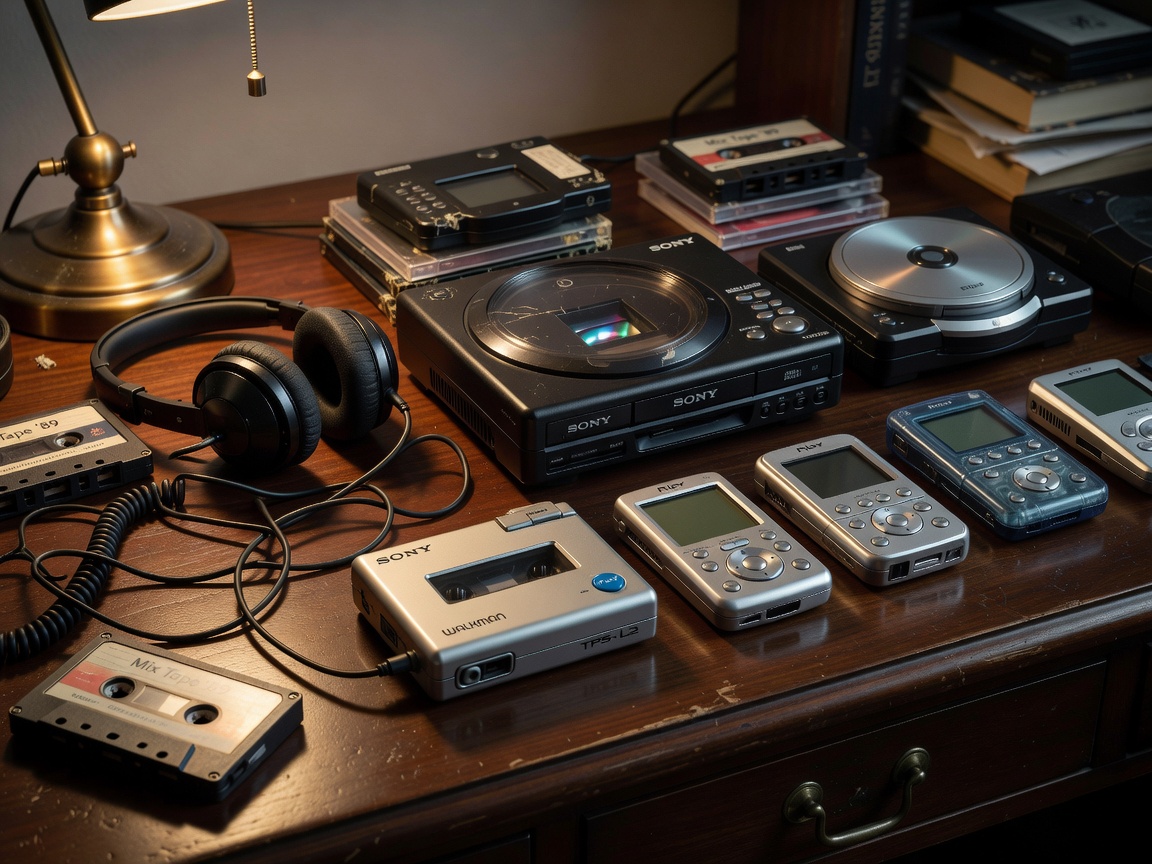
The Portable Cassette Culture
The Sony Walkman popularized the concept of personal, portable music in the 80s, but cassette culture peaked in the 90s. The mixtape was an art form—a meticulously curated sequence of songs recorded off the radio or copied from friends' collections. The physical constraints of a 60 or 90-minute tape forced the creator to make hard choices. You couldn't just shuffle; you committed to the linear journey. Fast-forwarding and rewinding drained precious battery life, and fixing a chewed tape with a #2 pencil was a required survival skill.
The CD Skip Era
As the compact disc superseded the cassette for home listening, the portable CD player (colloquially dominated by Sony's Discman) became the must-have gadget. However, bringing a spinning optical disc into the real world presented immediate physical challenges. Walking too fast, jogging, or taking a hard step caused the laser to lose its track, resulting in a jarring skip.
Hardware manufacturers waged a war over "Anti-Skip Protection." Early models featured a 3-second electronic shock protection memory buffer; by the late 90s, high-end models boasted up to 45 seconds of memory, aggressively reading ahead of playback to ensure uninterrupted audio during turbulent bus rides.
| Format | Portability | Audio Quality | Major Drawback |
|---|---|---|---|
| Cassette Tape | High (fits in pocket) | Analog, degrades over time | Tape chewing, linear playback only |
| Compact Disc (CD) | Low (bulky, requires case) | High (Digital lossless) | Skipping from physical shock |
| MiniDisc (MD) | High (small, durable) | Near-CD (ATRAC compression) | High cost, niche market adoption |
| Early MP3 | Extreme (flash memory) | Variable (low bitrate common) | Tiny storage (often 32MB - 64MB) |
MiniDisc: The Lost Format
Caught between the CD and the MP3 was Sony's MiniDisc format. Introduced in the early 90s but finding its cult following toward the end of the decade, the MiniDisc was a technological marvel. It offered the skip-free durability and recordability of a cassette tape with the random-access track skipping and digital quality of a CD. Encased in durable plastic shells, these small discs felt like something out of a sci-fi movie. While incredibly popular in Japan and parts of Europe, high hardware costs prevented it from achieving mainstream dominance in North America before digital files took over.
Dawn of the MP3 Player
The late 90s brought the dawn of digital audio files. Early MP3 players, like the Diamond Rio PMP300, held a staggering 32MB of onboard memory. In practical terms, this meant you could carry about eight to ten songs encoded at 128kbps. Managing your portable library meant daily synchronization sessions with a bulky desktop computer over a slow parallel or USB 1.0 cable.
It was a clunky, low-fidelity start, but the writing was on the wall. The physical constraints of media were vanishing. The iPod's eventual release in 2001, boasting a 5GB hard drive ("1,000 songs in your pocket"), was the final nail in the coffin for physical portable media, changing our relationship with music forever.